
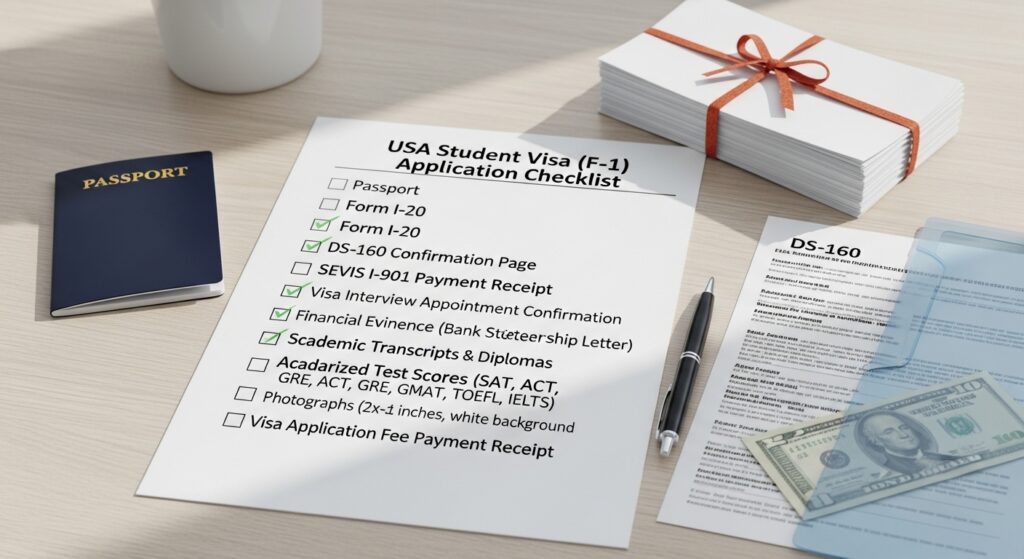
Preparing for a US F‑1 student visa interview means bringing a full set of required documents to the consulate. This guide will provide for you a clear checklist of all US student visa documents that you’ll be needing; from your passport and Form I-20, to your DS-160 confirmation, SEVIS fee receipt, financial proofs, transcripts, test scores, passport photos, and more, along with concise explanations. Highlighting the common mistakes and the tips for organizing your paperwork will also be discussed. Since requirements can vary by country, always double-check your local U.S. embassy or consulate website since there might be some additional instructions[1][2].
Checklist for the Required Documents Needed to Obtain a US Student Visa
- Valid Passport and Photos: Your passport must be valid for at least six months beyond your stay in the U.S. Carry any old passports with previous U.S. visas and bring two printed 2×2 inch visa photos in case your digital upload fails[3].
- Form I-20 (Certificate of Eligibility): This is your primary proof of eligibility for F-1 status. You must present the original form, physically signed by both you and your school official[7]..
- DS-160 and Appointment Confirmation: Print the confirmation page with the barcode once you complete your online visa application. Additionally, bring your printed interview appointment letter, as many consulates require it for entry into the building[4].
- Payment Receipts (SEVIS & MRV): You must show proof of payment for the $350 SEVIS I-901 fee and the visa application (MRV) fee. Keep the printed receipts or transaction records ready, as these are required before a visa can be issued[8][9].
- Financial Evidence: You must prove you have sufficient funds to cover tuition and living expenses for at least the first year. Bring original bank statements, scholarship letters, or an affidavit of support that matches the figures listed on your I-20[12][13].
- Academic Records and Test Scores: Carry official transcripts, diplomas, and standardized test reports (like TOEFL, IELTS, or GRE) from all previously attended institutions. These prove your academic preparation and that you meet the university’s admission standards[10] [11].
- Proof of Intent to Return & Translations: Be prepared to show “strong ties” to your home country, such as property deeds or job contracts, to prove you will depart after your studies[12]. Ensure any document not in English is accompanied by a certified English translation[14][15].
Common Mistakes That Can Stall Your Application: Steps on How to Avoid These
Preparing for your interview is about more than just what you say; it’s about ensuring your paperwork doesn’t raise any red flags. To keep your application on track, avoid these four frequent pitfalls:
- Document Inconsistencies and Expirations: Ensure all names, dates, and details match exactly across your forms and certificates, as typos can cause immediate suspicion[16]. Most importantly, check that your passport is not expiring; a passport that expires within six months of your program’s start date is generally not valid for visa issuance[3].
- Disorganized Paperwork: Scrambling to find a specific document during the interview wastes the few minutes you have with the officer and can negatively impact your case. Keeping your files messy or hard to navigate makes you appear unprepared[17].
- Outdated or Mismatched Financials: Never bring old bank statements; consular officers typically expect to see financial evidence from the last 3–6 months[18].Additionally, ensure the total funds shown in your documents align perfectly with the amounts listed on your Form I-20.
- Rushing the Process and Ignoring Local Rules: Only schedule your interview once you have the final, signed I-20 and your SEVIS fee is fully paid[8].Furthermore, failing to follow specific instructions from your local embassy, such as local form requirements or medical exams, can result in your interview being abruptly rescheduled[1][2].
Tips for Organizing Documents for the Interview
- Use a clear folder or binder: Arrange papers in logical sections (e.g. Personal Documents, Financials, Academics). Label tabs or use colored tabs to separate categories. This lets you and the officer quickly find what you need[17].
- Checklist and cross-off: Make a checklist of all items on the visa appointment website and tick them off as you pack. Bring extra copies of major documents (especially financial statements and I-20).
- Keep originals on top: Place originals at the front of each section (passport, I-20, transcripts). Officers usually want to inspect originals first.
- Have digital backups: Keep scanned copies (or photos) of every document on your phone or email, in case you misplace something.
- Practice your organization: Before the interview, do a mock run. Pretend the officer asks for your bank statement or DS-160, and make sure you can pull out the correct paper in seconds.
- Be concise with supplemental info: If you include any extra info (like a resume or cover letter), keep it very brief. The officer should understand each document’s purpose at a glance[17].
Sources
U.S. Department of State. (n.d.). Student Visa (F/M) – Required Documentation. travel.state.gov. Retrieved April 2026, from https://travel.state.gov/content/travel/en/us-visas/study/student-visa.html[14][19].
University of Michigan International Student Visa Knowledge Base. (n.d.). SEVIS Fee Required if Applying for F or J Visa. Retrieved 2026, from https://teamdynamix.umich.edu/TDClient/154/Portal/KB/ArticleDet?ID=7898[15].
NAFSA: Association of International Educators. (2025, August 14). 10 Points to Remember When Applying for a Student Visa. Retrieved April 2026, from https://www.nafsa.org/professional-resources/browse-by-interest/10-points-remember-when-applying-student-visa[13][20].
American University ISSS Office. (n.d.). 10 Tips for a Successful Visa Interview (F-1 and J-1 Visas). Retrieved 2026, from https://www.american.edu/student-affairs/isss/visa-interview-tips.cfm[17].
[1] [3] [4] [5] [6] [7] [10] [11] [12] [14] [19] Student Visa
https://travel.state.gov/content/travel/en/us-visas/study/student-visa.html
[2] [13] [20] 10 Points to Remember When Applying for a Student Visa | NAFSA
https://www.nafsa.org/professional-resources/browse-by-interest/10-points-remember-when-applying-student-visa
[8] [9] [15] Article – SEVIS Fee Required if Apply…
https://teamdynamix.umich.edu/TDClient/154/Portal/KB/ArticleDet?ID=7898
[16] [18] Blog-Visa Wahala: 5 Common Mistakes Students Make During the Visa Process (And How You Can Avoid Them) | Findadmission
https://findadmission.com/article?id=16
[17] 10 Tips for a Successful Visa Interview | American University, Washington, DC
https://www.american.edu/student-affairs/isss/visa-interview-tips.cfm